The Battle of Fromelles remains Australia’s worst day of warfare, with over 1700 deaths and 5000 injured. Books have been written about it, but in brief, it was intended to dissuade the movement of enemy troops from Fromelles to the Somme. One might have thought a few shells and a build-up of allied troops would have been enough, but an English general thought an assault was called for.
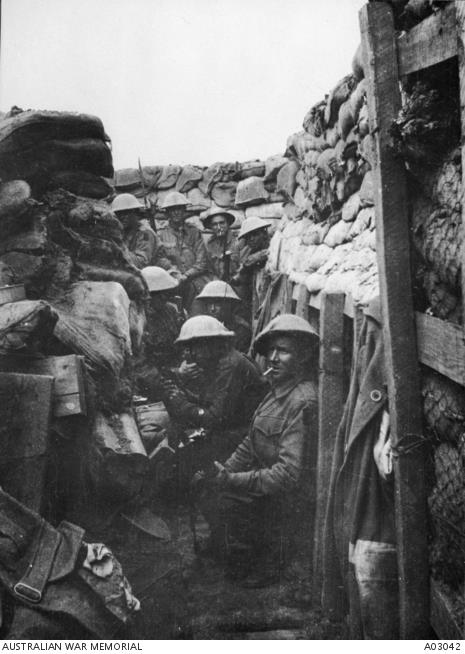
The German troops had occupied the area for two years and were well set up with field hospitals, a light railway, concrete bunkers and so on. The assault faced machine guns, the initial shelling was ineffective and the troops were slaughtered.
On the days following the battle, Helen’s great uncle, Simon Fraser, and others went into no-man’s-land to retrieve the wounded. He described it in a letter home – lean backwards, grab their arms, pull them onto your back, then run in a zig-zag pattern to avoid the snipers. The enemy offered a truce, but it was refused. Another 30 deaths resulted. Simon Fraser wrote in a letter that when collecting a wounded soldier, another called out: “Don’t forget me, Cobber!” Fraser was killed the following year.
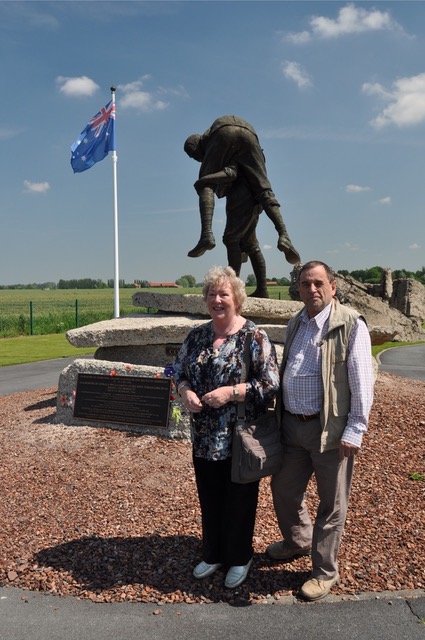
 The British and Australian Governments were not keen to publicise this disaster and it was not until fifty years later that the military historians began recording the details. Simon Fraser was in his late 30’s when he enlisted and wrote many letters back home. The historians got hold of these and were especially taken with that comment, displaying mateship at its ultimate. A statue was commissioned displaying Fraser carrying a wounded comrade, and was unveiled in 1998 in a new Memorial Park at Fromelles. The statue is mounted on the concrete of the German fortifications. A copy was made and unveiled in 2008 in the grounds of the Shrine in Melbourne. The school at Fromelles was called “L’Ecole Publique des Cobbers” and for a time had one clock showing local time and another set to Melbourne time, but when I checked in 2015, the Melbourne clock had disappeared.
Despite the overwhelming odds, many Australian soldiers made it through the German lines, only to be killed. Their bodies were buried by the German troops.
Many years later, an Australian art teacher, Lambis Englazos, who had studied WW1 intensively, claimed there were 250 soldiers buried at Fromelles who had never been recovered. (After the War, there were troops sent around to find bodies and to arrange a proper burial.) Lambis had to convince three Governments and various Army people that he had a case, though rare aerial photos of Fromelles before and after proved the existence of pits.
Eventually, an archaeological group were sent and they quickly discovered that the claims were valid, and the following year full exhumation began. Two hundred and fifty bodies were found and to date something in excess of 140 have been identified by DNA anlaysis.
A new War Cemetery was built nearby and (then) Prince Charles opened it in 2010. Our daughter Louisa flew over from London for the ceremony. We visited Fromelles in 2009 when exhumations were taking place, in 2012 to visit the new cemetery and 2015 to see the new Museum.
In 2012, while we were at the statue, a small group of British tourists appeared. One of them asked the tour leader who Simon Fraser was, and the tour leader confessed he did not know. Helen chipped in with the needed information, and was asked how she knew. When she told them she was his great niece, she instantly became a star attraction. The tour leader confided in me that if he had known she would be there, he would have charged them another fifty pounds!
 | To learn more about the historic Battle of Fromelles, read the book by Roger Lee forming part of the Australian Army Campaign Series, available to purchase online from Amazon and other booksellers. |